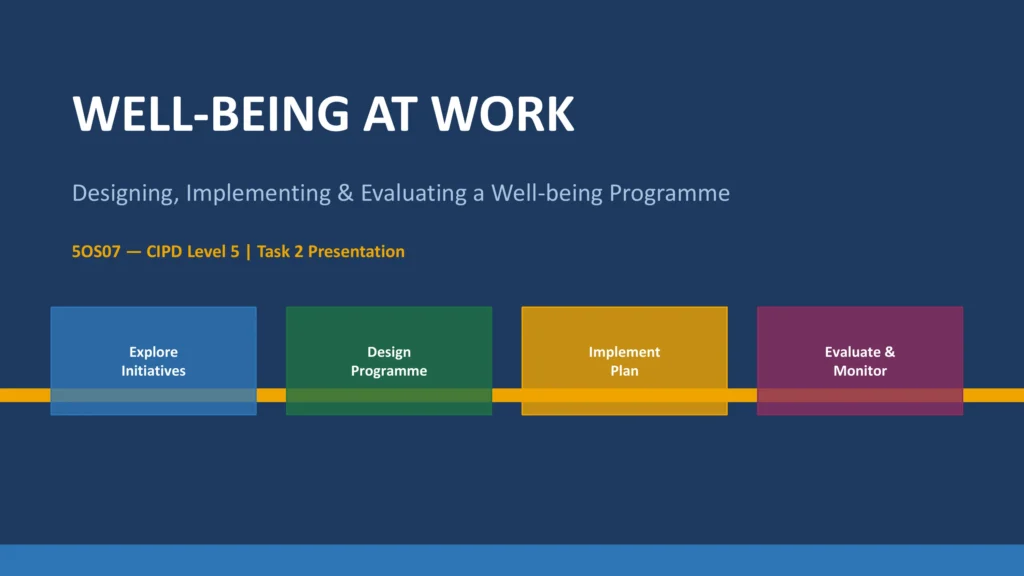
Designing, Implementing & Evaluating a Well-being Programme
SPEAKER NOTES – Slide 1: Introduction
5OS07 – CIPD Level 5 | Task 2 Presentation
Welcome to this presentation on developing a comprehensive well-being programme for our organisation. Well-being at work has never been more important: the COVID-19 pandemic accelerated a mental health crisis that was already building across UK workplaces, and our organisation has rightly identified employee well-being as one of its key People Strategic Objectives for the next three years. In this presentation, I will take you through four interconnected themes: exploring the well-being initiatives that are most relevant to our organisational needs; the design of a tailored well-being programme; how we would implement it in a structured and sustainable way; and how we will evaluate and monitor its impact to ensure continuous improvement. Each section maps directly to the assessment criteria for CIPD 5OS07 – CIPD Level 5 | Task 2 Presentation, and together they constitute a coherent blueprint for action. I hope this presentation equips you not only with knowledge but with practical direction for the conversations and decisions that lie ahead.
Exploring Well-being Initiatives (AC 3.1)
SPEAKER NOTES – Slide 2: Exploring Well-being Initiatives (AC 3.1)
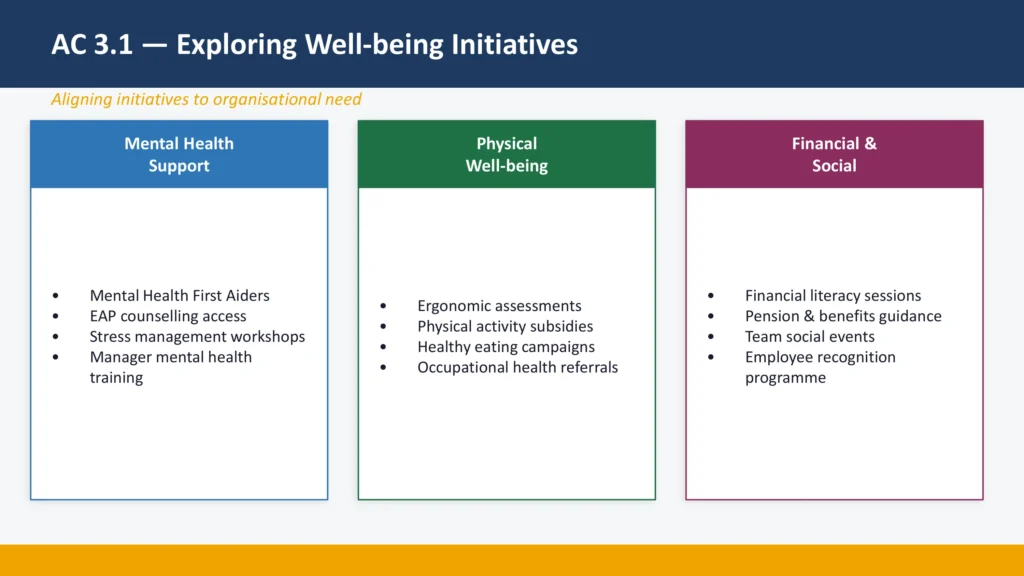
Exploring well-being initiatives begins with understanding our organisation’s specific needs, which means going beyond general best practice to interrogate our own absence data, employee survey results, EAP utilisation patterns and manager feedback. The CIPD’s 2023 Health and Well-being Report identifies mental health, financial stress and lack of social connection as the three most pressing well-being challenges facing UK employers today, all themes that resonate strongly in our post-pandemic context. The three clusters of initiatives shown here: mental health support, physical well-being and financial and social well-being, reflect a whole-person approach consistent with CIPD’s recommended framework. A thorough needs analysis should precede initiative selection: a staff survey, focus groups segmented by role and demographic, and analysis of occupational health referral patterns will reveal where the greatest need and appetite for support lies. This evidence base is essential to ensure we invest resource where it will have the greatest impact rather than defaulting to visible but low-utilisation perks. The initiative landscape should also be reviewed against benchmark organisations in our sector.
Organisational Needs Analysis (AC 3.1)
SPEAKER NOTES – Slide 3: Organisational Needs Analysis (AC 3.1)
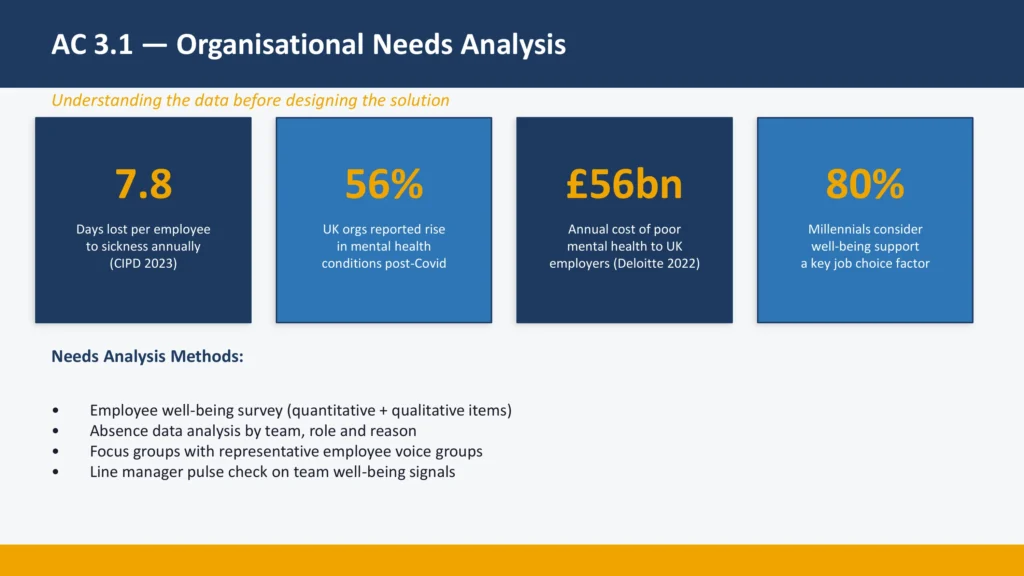
Before any programme design work begins, a robust needs analysis is non-negotiable. The statistics on this slide illustrate the scale of the challenge at a national level and help contextualise whatever our own internal data reveals. Well-being interventions that are not grounded in evidence risk investing resource in initiatives that are visible but not impactful, such as yoga classes for a workforce whose primary stressor is excessive workload or job insecurity. Our needs analysis should use a mixed-methods approach: quantitative data from our HR systems (absence rates, turnover by department, EAP referral volumes) provides the scale and patterns, while qualitative input through focus groups and manager conversations provides the ‘why’ and the contextual texture. It is important that the needs analysis is conducted with genuine transparency and that employees trust that their input will be acted upon; otherwise participation rates will be low and the data will be skewed. The People Team should also disaggregate the data by demographic group to identify whether certain cohorts for example, women, disabled employees or those in demanding operational roles experience disproportionate well-being challenges.
AC 3.2 – Designing the Well-being Programme
SPEAKER NOTES – Slide 4: Designing the Well-being Programme (AC 3.2)
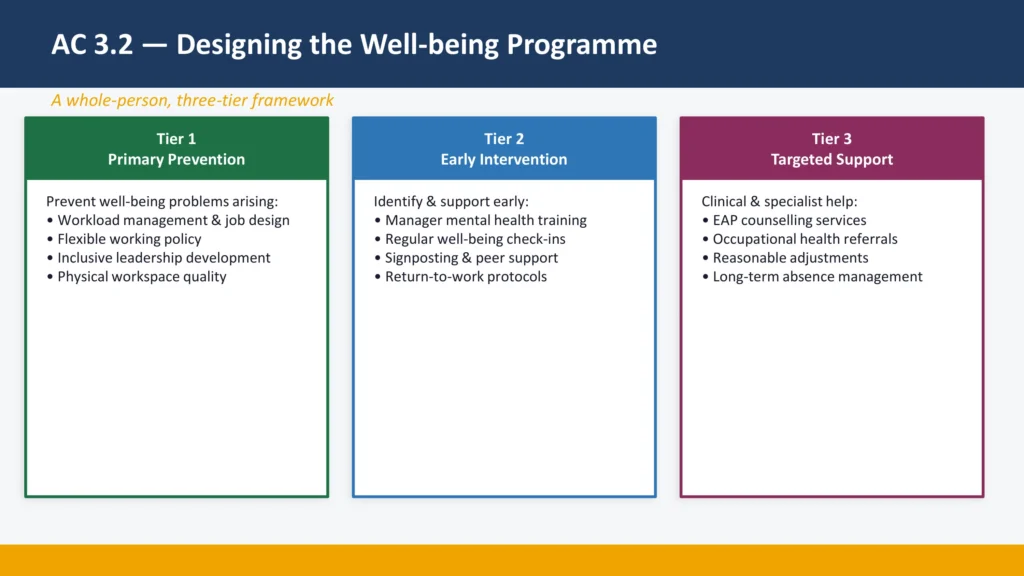
A well-designed well-being programme is structured around three tiers that together create a comprehensive and proportionate response to employee need. This tiered architecture is consistent with public health thinking and is well-supported by CIPD and NICE guidance on workplace well-being. Tier 1 – primary prevention, is the most cost-effective investment because it prevents well-being problems from arising in the first place. This means designing work well: managing workloads, enabling flexibility, ensuring physical environments are ergonomic and psychologically safe, and building inclusive leadership practices that prevent exclusion and unfairness. Tier 2 – early intervention, catches problems before they escalate into clinical conditions requiring extended absence. Equipping managers to have well-being conversations, creating psychological safety for disclosure, and ensuring rapid signposting to support are the critical mechanisms at this tier. Tier 3 provides specialist clinical and occupational health support for employees who have already developed more significant conditions, facilitating recovery and sustainable return to work. This three-tier model ensures the programme is both proactive and reactive, it prevents, detects and treats.
AC 3.2 – Programme Framework: Key Pillars
SPEAKER NOTES – Slide 5: Six Pillars of the Well-being Programme (AC 3.2)
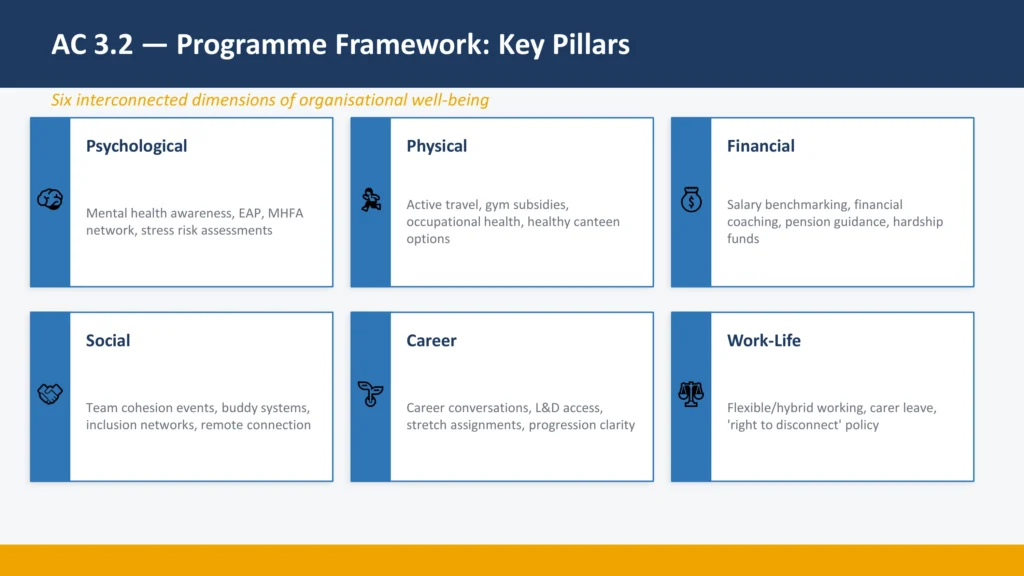
This slide presents the six interconnected pillars that will form the structural backbone of our well-being programme. Grounding the design in a multi-dimensional model of well-being is essential because employee well-being cannot be reduced to mental health alone. Iit is a product of psychological, physical, financial, social, career and work-life balance dimensions working in concert. Research by Robertson Cooper and Warwick University consistently demonstrates that interventions which address multiple dimensions simultaneously are significantly more effective than single-focus programmes. The psychological pillar encompasses mental health first aider networks, EAP access and manager training. The physical pillar promotes movement, ergonomics and nutrition. The financial pillar addresses the growing issue of financial stress, which the CIPD 2023 survey identified as affecting over one-third of the workforce. The social pillar rebuilds connection that was fractured during the pandemic. The career pillar addresses the well-being impact of stagnation, uncertainty and lack of development. The work-life balance pillar formalises the organisation’s commitment to sustainable working practices. Together, these six pillars constitute a whole-person programme that addresses employees as complete human beings rather than units of productive capacity.
AC 3.3 – Implementing the Well-being Programme
SPEAKER NOTES – Slide 6: Implementing the Well-being Programme (AC 3.3)
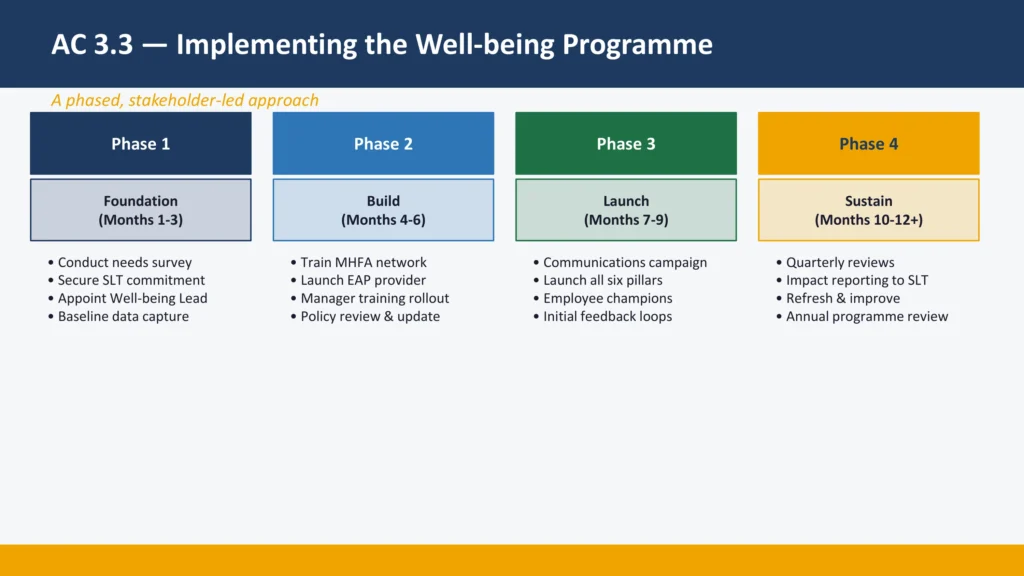
Effective implementation requires a structured, phased approach that builds the foundations before launching headline initiatives. The four-phase model on this slide spans twelve months and is designed to be realistic and sustainable rather than overly ambitious. Phase 1 – Foundation – is arguably the most critical because it establishes the data, leadership commitment and governance infrastructure upon which everything else depends. Securing visible SLT sponsorship, designating a Well-being Lead with dedicated time and budget, and capturing robust baseline data are the non-negotiables of this phase. Phase 2 – Build – focuses on infrastructure: training the Mental Health First Aider network, contracting an EAP provider, building manager capability and updating policies to reflect our well-being commitments. Phase 3 – Launch – involves the internal communications campaign that makes the programme visible and credible to all employees, and the activation of all six programme pillars. Phase 4 – Sustain – embeds well-being as an ongoing organisational practice rather than a one-off initiative, with quarterly data reviews, stakeholder check-ins and a formal annual programme evaluation. Communication throughout all phases must be clear, consistent and authentic, with leadership visibly championing the programme to signal cultural permission.
AC 3.3 – Roles & Responsibilities in Implementation
SPEAKER NOTES – Slide 7: Roles and Responsibilities (AC 3.3)
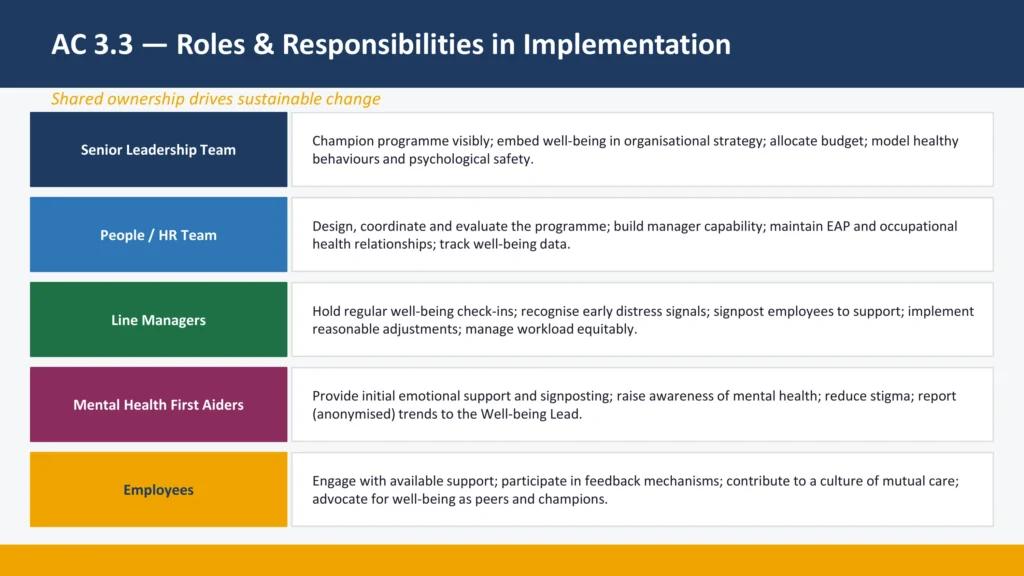
One of the most common reasons well-being programmes fail is that ownership is not clearly distributed. The People Team ends up holding sole accountability for what is fundamentally an organisation-wide cultural challenge. This slide makes explicit the distinct but interdependent contributions of each stakeholder group. The SLT’s role is primarily cultural and strategic: without their visible commitment, any well-being initiative will be perceived as performative rather than genuine. CIPD research consistently shows that employees who see their senior leaders modelling healthy behaviours, taking leave, maintaining boundaries, speaking openly about stress, are significantly more likely to engage with well-being support themselves. The People Team provides the design, coordination and analytical infrastructure. Line managers are the critical delivery mechanism, translating policy into daily practice through their interactions with employees. Mental Health First Aiders bridge the gap between clinical services and everyday workplace relationships. Employees themselves are active participants rather than passive recipients: their feedback, peer support and co-creation contributions ensure the programme remains relevant and trusted. Clarifying these roles in a well-being policy document and communicating them through all-staff communications will reduce ambiguity and distribute ownership effectively.
Evaluating and Monitoring the Programme (AC 3.4)
SPEAKER NOTES – Slide 8: Evaluating and Monitoring the Programme (AC 3.4)
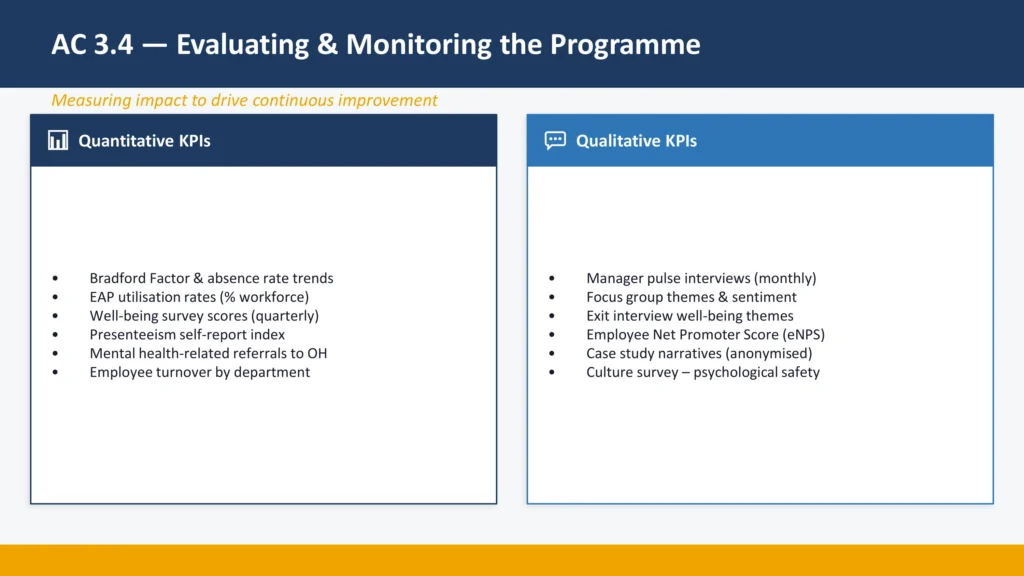
Evaluation is not an afterthought. It is integral to the programme architecture and should be planned from the outset. Without rigorous evaluation, we cannot determine whether our interventions are working, identify unintended consequences or make the business case for continued investment. The evaluation framework on this slide uses a mixed-methods approach, combining quantitative Key Performance Indicators with qualitative insight to build a rich and accurate picture of programme impact. On the quantitative side, absence rates (using the Bradford Factor for short-term intermittent absence alongside total days lost) provide the most direct proxy for well-being outcomes, and our baseline data from Phase 1 allows us to track change over time. EAP utilisation rates indicate both accessibility and need. Quarterly well-being survey scores, derived from validated instruments such as the CIPD’s Well-being Indicator or the Warwick-Edinburgh Mental Wellbeing Scale, enable longitudinal tracking. Qualitative evaluation, through manager pulse interviews, focus group themes and exit interview analysis, provides the explanatory depth that numbers alone cannot offer. Together, these data sources enable the People Team to produce a quarterly well-being dashboard for the SLT and an annual programme review that drives evidence-based improvement.
AC 3.4 – Evaluation Framework & Governance
SPEAKER NOTES – Slide 9: Evaluation Framework (AC 3.4)
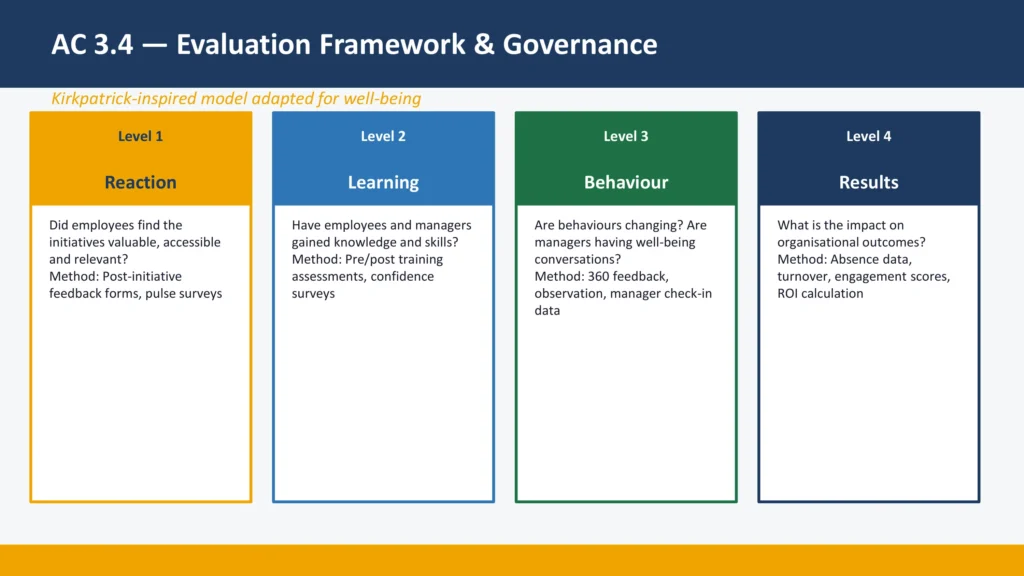
This slide applies a Kirkpatrick-inspired four-level evaluation model to our well-being programme, adapting this widely-used training evaluation framework to the well-being context. Level 1 Reaction, asks whether employees found our initiatives useful and accessible. This is the easiest level to measure but the least predictive of impact; positive reactions are necessary but not sufficient for demonstrating value. Level 2 Learning, assesses whether our interventions have built new knowledge and skills: are managers more confident having mental health conversations? Do employees know how to access EAP support? Level 3 Behaviour is where the real test of programme efficacy lies: have attitudes and practices actually changed in the day-to-day? Are line managers conducting well-being check-ins? Is psychological safety increasing? This level requires more sophisticated measurement through observation, 360 feedback and manager data. Level 4 Results connects well-being investment directly to organisational outcomes. By tracking changes in absence rates, turnover, engagement scores and where possible productivity proxies against the cost of the programme, we can calculate a return on investment and make a compelling business case for ongoing commitment. The Well-being Lead will produce a quarterly dashboard covering all four levels and present findings to the SLT steering group, ensuring evaluation drives decision-making rather than simply documenting activity.
Summary & Key Takeaways
SPEAKER NOTES – Slide 10: Summary & Conclusion
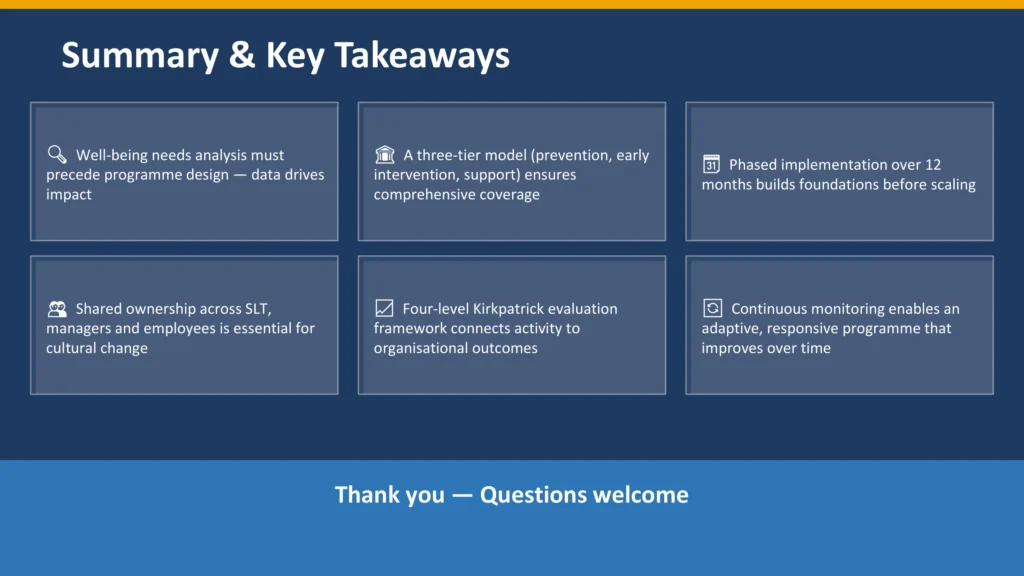
In closing, I want to bring together the key messages from this presentation and leave you with a clear sense of direction. Our organisation has both the opportunity and the obligation to take employee well-being seriously, not as a reactive welfare exercise, but as a strategic investment in the capability, resilience and humanity of our workforce. The evidence is unambiguous: organisations that invest in genuine, evidence-based well-being programmes see measurable returns in reduced absence, higher engagement, improved retention and enhanced organisational reputation. The programme I have outlined today is grounded in a thorough needs analysis, structured around a whole-person six-pillar model, implemented through a phased and stakeholder-led plan, and evaluated with rigour using a four-level framework. It is ambitious but achievable. The critical success factors are visible SLT commitment, adequate resource allocation, manager capability and a culture of psychological safety in which employees feel safe to engage. I welcome your questions and look forward to working collaboratively to develop this programme into a flagship strategic initiative for our organisation. Well-being is not a destination, it is an ongoing practice of care, and the work starts now.